Best Web Hosting for Small Business in 2026: 5 Hosts Compared (With Real Renewal Costs)
Disclosure: Some links below are affiliate links. If you buy through them, I may earn a commission at no extra cost to you. This doesn’t change the prices or the pros and cons listed. Prices change often, so confirm on the provider’s site before buying.
Written & reviewed by GuideMyHost
Hosting guides, comparisons and practical website advice.
Last updated: October 1, 2026
The Short Answer
There’s no single best host for every small business. The right pick depends on your budget, your technical comfort, and where your customers are.
| If you… | Choose | Why |
|---|---|---|
| Are launching a first WordPress site | Bluehost | Guided setup, endorsed by WordPress.org |
| Want flexible hosting with multiple websites and daily backups | DreamHost | 25 websites, daily automated backups, and flexible hosting options |
| Care about eco-friendly hosting | GreenGeeks | Renewable-energy matching, solid starter features |
| Run a growing store or busy site | Cloudways | Scalable managed cloud, no contract |
| Are an Australian business wanting local billing and domains | Crazy Domains | AUD pricing and .com.au domains, with caveats below |
The one rule that matters most: judge hosts by their renewal price, not the sign-up deal. That gap is where most beginners get caught.
How I Evaluated These Hosts
I compared each host on the factors that affect a small business most:
- True cost: introductory price, renewal price, and billing term
- Included features: SSL, backups, email, storage type, number of sites
- Risk: refund window, contract length, cancellation process
- Performance signals: server speed and uptime from independent testing where available
- Support and billing reputation: customer review patterns, not just marketing claims
- Fit: who each plan suits and who should avoid it
Sources: Provider pricing pages, provider help documentation, and third-party review sites, cross-checked. Where sources disagreed (this happens often with promo pricing), I show a range instead of picking one number.
Independent Performance Data
Real Cost Comparison: Entry Plans
Most hosts advertise the first-term price. This table shows what you’ll pay afterwards.
| Host | Entry plan | Intro price | Renewal price | Refund window |
|---|---|---|---|---|
| Bluehost | Starter | $3.99/mo on a 36-month term, renewing at $9.99/mo | $9.99/mo (36-month) | 30 days (confirm at checkout) |
| GreenGeeks | Lite | $2.95/mo on a 12-month prepaid term | About $12 to $14/mo (sources differ; $13.95 is the latest listed) | 30 days |
| DreamHost | Launch | $2.89/mo (1-year term) | $10.99/mo after 1 year | 30 days on shared plans |
| Cloudways | DigitalOcean Standard | $11/monthly | Pay-as-you-go; no promotional renewal jump | Check current trial/refund terms |
| Crazy Domains | Economy (shared) | A$11.22/mo (1-year term) | Check current renewal price | 60 days |
Prices in USD except Crazy Domains (AUD). Excludes tax and optional add-ons.
Current Hosting Costs: Intro Price vs Renewal Price
Hosting companies often advertise promotional pricing for the first term. The renewal price is usually higher, so compare both before choosing a plan. Prices can vary by billing term, location, taxes and promotional offers. Always confirm the final price at checkout.
Need help choosing the right hosting plan?
Have questions or facing any problems? Contact us — we’ll guide you and help you choose the hosting option that best fits your website, budget, and business needs.
What Is Web Hosting? (30-Second Explanation)
Your website is a collection of files. Web hosting is the service that stores them on a server so visitors can load your site at any time. Your domain is your address. Hosting is the building.
For a small business, hosting affects four things:
- Speed: slow pages lose visitors and hurt search rankings.
- Uptime: downtime means missed enquiries and sales.
- Security: SSL and backups protect customer trust.
- Growth: you should be able to upgrade without rebuilding.
What is web hosting and how does it work?
How to Choose a Web Host for a Small Business
1. Compare renewal prices. Intro rates usually require a 1 to 3 year prepayment. Ask what year two costs.
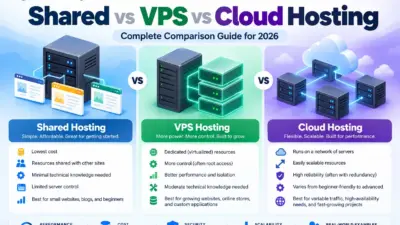
2. Match the hosting type to your stage. Shared hosting suits new, low-traffic sites. WordPress-optimized plans simplify management. Cloud or VPS suits busy sites and stores. [Internal link: Shared vs VPS vs cloud hosting]
3. Check for hidden costs. Domain renewal, backups, domain privacy and business email are sometimes extra. For example, Cloudways bills off-site backup storage per gigabyte and charges for bandwidth overages.
4. Look at the refund window. A longer window gives you time to test speed and support with a real site.
5. Plan for email. Some plans include mailboxes and some don’t. If email is critical to your business, a dedicated service such as Google Workspace or Microsoft 365 is often more reliable than bundled hosting email.
6. Check server location. Pick a data center near your customers. This matters most for Australian and other regional audiences.
1. Bluehost: Best for Beginners and First WordPress Sites
Best for: First-time owners, local service businesses, WordPress sites.
Bluehost’s main appeal is a smooth start. It’s endorsed by WordPress.org, and the first-year bundle includes a free domain, SSL and CDN.
| Plan | Intro (36-mo) | Renewal (36-mo) |
|---|---|---|
| Starter | $3.99/mo | $9.99/mo |
| Business | $6.99/mo | $13.99/mo |
| eCommerce Essentials | ~$14.99/mo | $21.99/mo |
Pros
- Beginner-friendly setup and dashboard
- Among the lower renewal rates for mainstream shared hosting
- Reasonable upgrade path to WooCommerce, cloud and VPS
Cons
- Renewal pricing roughly triples after the intro term
- Shared plans don’t include a guaranteed dedicated backup service in the base price
- Paying month to month costs much more: the Starter monthly renewal rate is $15.99
Choose it if you want the easiest first launch and plan to stay at least three years.
Skip it if you want a long refund window or the lowest possible cost.
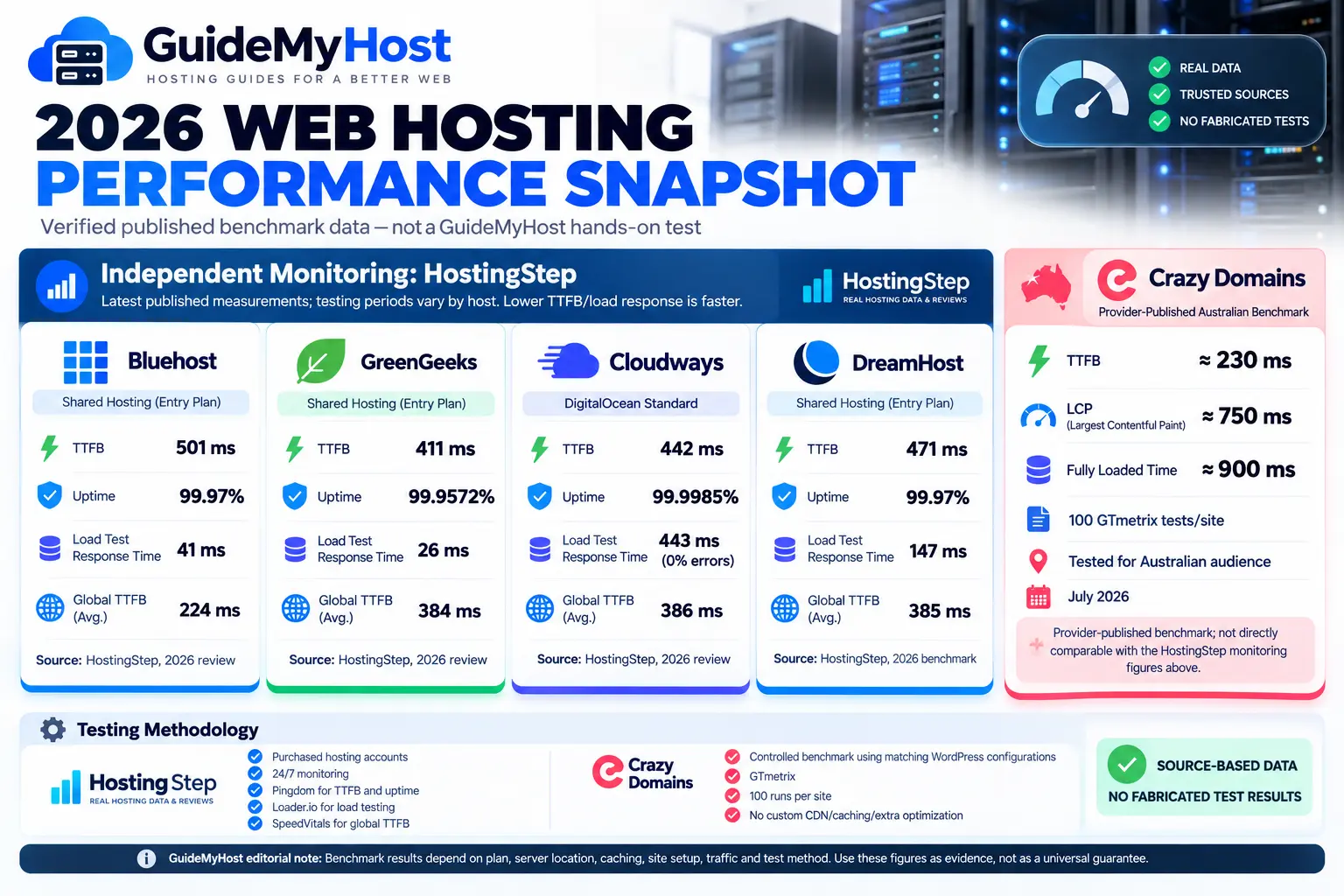
Independent performance notes: TTFB: 411 ms · Uptime: 99.99% · Load test: 41 ms (0% errors) · Global TTFB: 224 ms · Monitoring period: November 1, 2025–August 31, 2026 · Source: HostingStep [Source: HostingStep]
👉 [Check Bluehost’s current plans →]
2. DreamHost: Best for Flexible Small-Business Hosting
Best for: Small businesses, freelancers and website owners who want flexible billing, multiple websites and a long-standing hosting provider.
DreamHost’s current Launch plan is designed for new and growing websites. It includes hosting for up to 25 websites, 25 GB of NVMe storage, daily automated backups, free SSL, a free domain for one year on annual plans, and three months of professional email. DreamHost also offers month-to-month web hosting, although monthly pricing is higher than annual plans.
| Plan | Intro Price | Renewal | Key Features |
|---|---|---|---|
| Launch | $2.89/mo | $10.99/mo | 25 websites, 25 GB NVMe, daily backups |
| Growth | $3.99/mo | $12.99/mo | 50 websites, 50 GB NVMe |
| Scale | $9.99/mo | $25.99/mo | 100 websites, 100 GB NVMe |
DreamHost currently provides a 30-day money-back guarantee on shared Web Hosting plans.
Pros
- 25 websites on the entry Launch plan
- Daily automated backups included
- Month-to-month hosting is available
- Free SSL and a free domain for one year on annual plans
Cons
- Renewal pricing is higher than the introductory rate
- The custom control panel is different from cPanel
- Professional email is only free for the first three months on current Launch plans
Choose it if you need multiple websites, daily backups, and a flexible hosting plan for a growing small business.
Skip it if you specifically want cPanel or need a very low renewal price.
Our experience: We personally use DreamHost and have not experienced website or support issues during our use. This is our own experience and should not be taken as a guarantee for every customer.
Independent performance data: DreamHost Shared recorded 471 ms TTFB, 99.97% uptime, 147 ms load-test response and 385 ms global TTFB in HostingStep’s October 2025–August 2026 benchmark window. Results can vary by plan, location and website setup. Source: HostingStep.
👉 Check DreamHost’s current plans
DreamHost review · Hosts with the best money-back guarantee
3. GreenGeeks: Best Eco-Friendly Web Hosting
Best for: Sustainability-minded brands, small WordPress sites.
GreenGeeks markets itself on renewable energy matching, which you can mention on your own site if sustainability is part of your brand. Included features are solid: free SSL, a free domain for a year, migration assistance and a 30-day refund window.
| Plan | Intro (12-mo) | Renewal |
|---|---|---|
| Lite | $2.95/mo | $13.95/mo |
| Pro | $4.95/mo | $18.95/mo |
| Premium | $8.95/mo | $30.95/mo |
Another tracker lists lower renewal rates (Lite near $11.95), so confirm your exact renewal price at checkout.
Pros
- Competitive intro pricing
- Third-party testing recorded roughly 416 ms average response time and 99.97% uptime (one reviewer’s results, not a guarantee)
- Pro and Premium support unlimited sites
Cons
- Among the steepest renewal jumps in this comparison
- Reviewers flag the cancellation process as a weak point
- Lite is limited to one website
Choose it if green hosting fits your brand and you’ll budget for the renewal price.
Skip it if your priority is the lowest long-term cost.
Independent performance notes: TTFB: 411 ms · Uptime: 99.9572% · Load test: 26 ms (0% errors) · Global TTFB: 384 ms · Tested plan: GreenGeeks Lite · Data center: Chicago · Monitoring period: October 1, 2025–May 31, 2026 ·
Source: HostingStep
👉 Check GreenGeeks’ current plans
4. Cloudways: Best for Growing Stores and Busy Sites
Best for: WooCommerce stores, sites that outgrew shared hosting, owners comfortable with a bit more setup.
Cloudways is managed cloud hosting. Instead of fixed shared plans, you choose a cloud provider and server size and pay for that server. Cloudways’ current Digital Ocean Standard entry plan is $11/month. The current configuration shown by Cloudways includes 2GB RAM, 1 vCPU, 50GB storage and 2TB transfer bandwidth. Pricing varies by cloud provider and server configuration.
Pros
- Scale resources up as traffic grows
- Pricing is per server, not per site
- No long contract or promo-price trap
Cons
- Email hosting isn’t included; it’s a paid add-on
- Add-ons (backup storage, bandwidth overage, premium support) can raise the total
- Less beginner-friendly than Bluehost or DreamHost
Independent performance notes: Cloudways Standard · TTFB: 442 ms · Uptime: 99.99% · Load test: 282 ms (2.14% errors) · Global TTFB: 386 ms · Monitoring period: November 1, 2025–August 31, 2026 · Source: HostingStep
Choose it if your site slows down on shared hosting or you run a store.
Skip it if you want the simplest, cheapest first site.
👉 Check Cloudways’ current plans
5. Crazy Domains: For Australian Domains and Budget Starter Sites
Best for: Australian businesses that want AUD billing, local domains and cPanel hosting from one provider.
Crazy Domains sells cPanel shared plans with free SSL, 24/7 support and a 60-day money-back guarantee. The Economy plan was listed at A$10.75/mo (GST-inclusive, one-year term) with 10GB of NVMe storage for one site. Other trackers show lower or higher figures depending on term, so check the cart total. .com.au domains start at A$14.49.
To register a .com.au domain you generally need an Australian presence, such as an ABN or ACN. Check the current eligibility rules before you buy.
Pros
- AUD pricing and local domain options
- cPanel is familiar and easy to move away from later
- Domains and hosting under one account
Cons and what to watch
- Billing reviews are mixed. ProductReview.com.au rates it 3.3 out of 5 from 1,915 reviews, with complaints concentrated on billing, support and reliability.
- Reviewers advise watching for pre-ticked add-ons at checkout and sharp renewal increases.
- Ownership: Crazy Domains and Bluehost share the same parent company. Newfold Digital’s Network Solutions Group includes Crazy Domains, and its Bluehost Group oversees Bluehost. They are separate brands, but it’s worth knowing when comparing “independent” opinions.
Choose it if you read the cart carefully, turn off unneeded add-ons, and put renewal dates in your calendar.
Skip it if your site is mission-critical and billing predictability matters more than a cheap first year. Compare at least one Australian-owned host too.
👉 Check Crazy Domains’ current plans
Feature Comparison at a Glance
| Bluehost | DreamHost | GreenGeeks | Cloudways | Crazy Domains | |
|---|---|---|---|---|---|
| Hosting type | Shared, WordPress, WooCommerce, VPS, cloud | Shared, DreamPress, VPS | Shared, WordPress, VPS | Managed cloud | Shared, WordPress, VPS |
| Business email included | Check plan | Unlimited plan only | Yes (limits vary) | No (add-on) | Yes, on shared plans (limits vary) |
| Free domain, year 1 | Yes (most plans) | Check plan | Yes | No | Check plan |
| Control panel | Custom/cPanel-style | Custom | cPanel | Custom | cPanel |
| Beginner-friendly | High | Medium to high | Medium | Low to medium | Medium |
| Scales to heavy traffic | Yes (cloud/VPS) | Yes (VPS) | Limited | Yes | Limited |
Confirm each row on the provider’s plan page before buying, as inclusions vary by plan and term.
Which Host Fits Your Situation?
- “First site, non-technical”: Bluehost.
- “Multiple websites with daily backups”: DreamHost Launch.
- “Multiple sites with email, tight budget”: DreamHost Shared Unlimited.
- “Brand values matter, and I’ll pay for it”: GreenGeeks, on Pro if you need more than one site.
- “Store getting busy”: Cloudways, with a separate email service.
- “Australian business, local domain”: Crazy Domains, after reading the cart carefully.
5 Costly Hosting Mistakes
- Choosing by intro price. Compare year-two cost.
- Skipping backups. Don’t assume they’re included; confirm.
- Ignoring auto-renew settings. Set reminders before renewal dates.
- Over-buying. Most new sites don’t need VPS or dedicated hosting.
- Never testing support. Ask a pre-sales question before paying.
How to Launch Your Website: 5 Steps
- Pick a short, brandable domain.
- Choose a plan sized for today’s traffic.
- Install WordPress (one click on most hosts).
- Confirm HTTPS works and set up backups.
- Set up business email before launch.
Frequently Asked Questions
What is the best web hosting for a small business?
For most beginners, Bluehost offers an easy starting point. DreamHost is a flexible option for businesses that need multiple websites and daily backups, while Cloudways is suited to growing stores and higher-resource websites.
How much does web hosting cost for a small business?
Entry shared plans start around $2.59 to $3.99 per month on promotional pricing, but renewals typically run $6 to $14 per month. Managed cloud starts around $11 per month. Always compare renewal prices.
Is shared hosting good enough for a small business?
Yes, for most new and brochure-style sites. Move to VPS or cloud hosting when pages slow down or traffic grows.
What’s the best web hosting for small business in Australia?
Look for AUD pricing, local support hours and a server near your customers. Crazy Domains offers local domains and AUD billing, but read its billing reviews and checkout add-ons carefully, and compare at least one Australian-owned alternative.
Which hosting is best for a small business online store?
A good WordPress or WooCommerce plan works for small catalogues. As traffic and orders grow, managed cloud hosting such as Cloudways offers more headroom.
Do I need separate email hosting?
Not always, but if email is essential to your business, a dedicated service like Google Workspace or Microsoft 365 is more dependable than bundled hosting email.
Can I switch hosts later?
Yes. Back up your site first and check whether your new host offers free migration.
Why does web hosting cost more at renewal?
Hosts discount the first term to win customers, then charge the standard rate. This is common across the industry. Longer prepaid terms usually lock in lower rates.
Final Verdict
Pick a host by renewal cost, refund window and fit for your stage, not by the sign-up banner.Bluehost offers a beginner-friendly starting point, DreamHost provides flexible multi-site hosting with daily backups, GreenGeeks focuses on eco-friendly hosting, Cloudways provides scalable managed cloud hosting, and Crazy Domains is focused on Australian domains and hosting. The right choice depends on your website, budget, technical needs and target audience.

[…] For current provider recommendations, see Best Web Hosting Providers. […]